
The Copyright Page: What to include
When self-publishing, there’s a lot to think about: writing, editing, cover design, typesetting, ISBNs, printing… and then there’s the copyright page.
It might be tucked quietly inside your book, but your copyright page is an important piece of publishing professionalism. It protects your work, provides essential information to readers and retailers, and helps your book look every bit as credible as traditionally published titles.
So, if you’re a UK indie author preparing to self-publish, here’s what you need to know.
What is a Copyright Page?
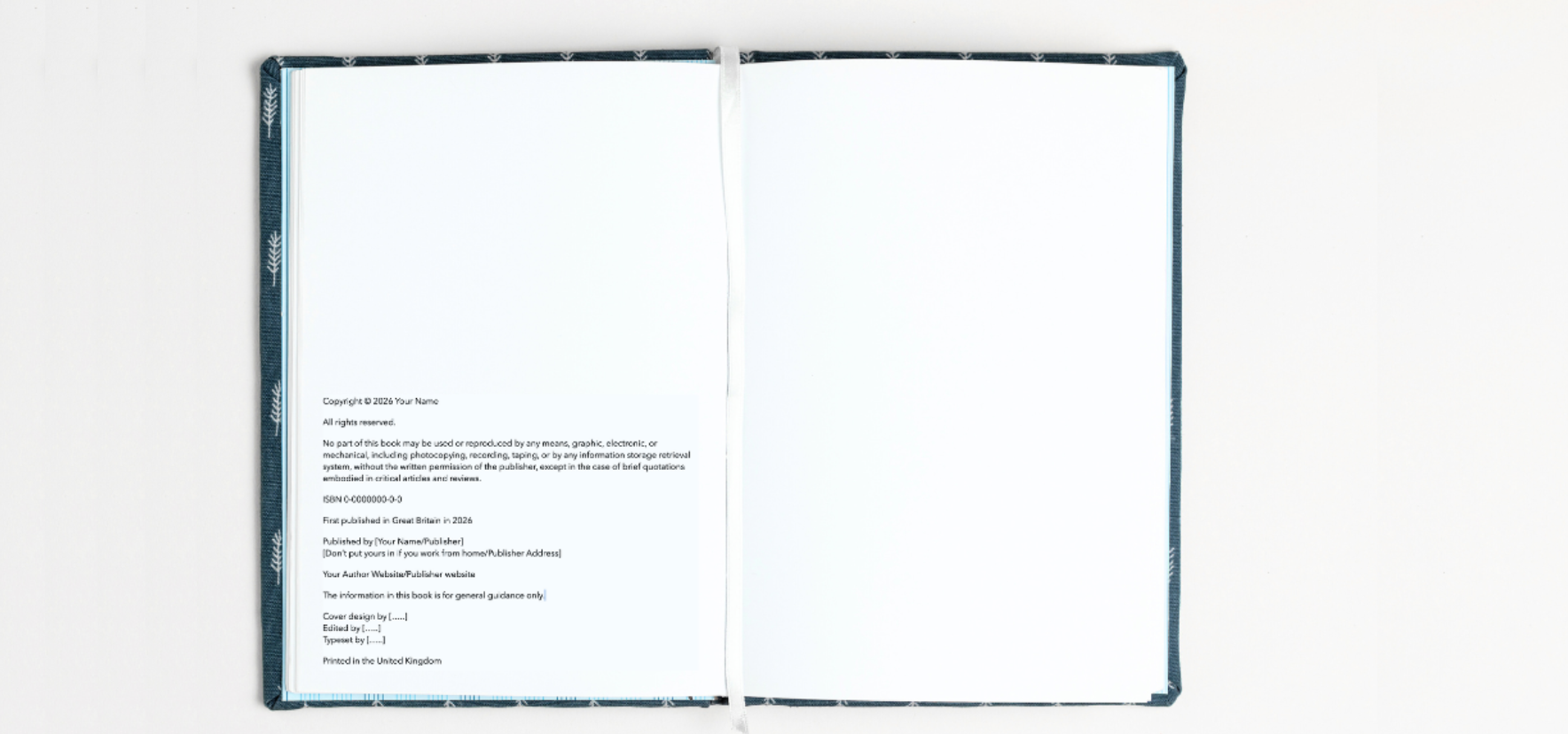
The copyright page is traditionally part of the ‘front matter’ of your book and is found on the reverse of the title page (the left-hand page just inside your book). It contains legal and publishing information about your work.
Readers might skim past it, but publishers, libraries, booksellers, and printers rely on it.
Why it matters
A well-prepared copyright page:
Protects your intellectual property
Confirms who owns the rights to the work
Provides bibliographic details for libraries and retailers
Makes your book look professional and complete
Avoids confusion over editions and formats
In short, it’s small, but mighty.
What to include on a UK Copyright Page
Here’s a breakdown of the key elements commonly used in UK-published books.
1. Copyright Notice
This confirms ownership of the text. You don’t have to register the copyright for your book; just put in the year the book was/will be first published and released for sale.
Example:
Copyright © [Author Name] [Year of publication]
If you’re publishing under a company name, use that instead.
Also, since the copyright symbol isn’t recognised in some countries, it is best to include it as a word to avoid confusion.
While this is all you need to include, most self-publishers include more information on their copyright pages for various legal and business reasons. So, here are more details on what to include:
2. Rights Statement
This statement informs the reader that rights are reserved under the copyright notice and should be respected. It explains how the work may (or may not) be reproduced.
Common wordings:
No part of this book may be used or reproduced by any means, graphic, electronic, or mechanical, including photocopying, recording, taping, or by any information storage retrieval system, without the written permission of the publisher, except in the case of brief quotations embodied in critical articles and reviews.
OR
All rights reserved. This book or any portion thereof may not be reproduced or used in any manner whatsoever without the express written permission of the publisher, except for the use of brief quotations in a book review or academic journal.
OR
All rights reserved. No part of this book may be reproduced in any form, by photocopying or by any electronic or mechanical means, including information storage or retrieval systems, without permission in writing from the author or the publisher of this book.
Given that this statement just reiterates the rights already granted by copyright protection and publishing contracts, some authors just include:
All rights reserved. OR All rights reserved. The moral rights of the author have been asserted.
3. Author or Publisher Details
Usually, your name and a contact email or website, or your publishing company and the publisher’s address.
Example:
Published by [Imprint or Author Name]
www.yourwebsite.co.uk
4. ISBN
If you’re using ISBNs (recommended for print and ebooks sold through retailers), list them here.
Example:
ISBN 978-1-xxxxxx-xx-x (paperback)
ISBN 978-1-xxxxxx-xx-x (ebook)
5. Edition Statement
Especially helpful if you plan multiple editions.
Example:
First published in Great Britain in 2026
6. Disclaimer (if needed)
Useful for fiction or advice-based non-fiction. Disclaimers do not offer full protection against being sued, but are widely used in book publishing.
Here are some standard short disclaimers (if you feel you need to include a longer disclaimer, you can put this on a separate page):
Fiction: This is a work of fiction. Any resemblance to actual persons, living or dead, events, or locales is entirely coincidental.
Creative Nonfiction: This is a work of creative nonfiction, and the information is for general guidance only.
OR
This is a work of creative nonfiction. Some parts have been fictionalised to varying degrees, for various purposes, with some names, dates, places, events, and details changed, invented, and altered for literary effect or to protect the privacy of the people involved.
Memoirs: The events and conversations in this book are accurate to the best of the author’s ability, although some names and details have been changed to protect the privacy of others.
7. Credits
Acknowledging cover designers, editors, illustrators, typesetters and/or sources of images.
Example:
Cover design by…
Edited by…
Typeset by…
8. Printing information (optional)
Some authors include printer details or print location.
Example:
Printed in the United Kingdom
Publications that do not need an ISBN
You will find a full list of publications that don’t require an ISBN on Nielsen’s website (www.nielsenisbnstore.com/Home/Isbn), so if you’re publishing something unusual, check it.
A few examples include:
Books for private distribution, e.g. to members of a club
Personal documents
Serials/periodicals/journals – these should have ISSNs
Puzzle books
Final Thoughts
For most indie authors, standard copyright page wording is widely used and perfectly acceptable. However, if you’re publishing specialist legal, medical, or financial advice books, professional legal guidance is recommended.
Your copyright page might be just one page in your book, but it carries a lot of weight. Getting it right ensures your work is protected, professional, and ready for retailers, libraries, and readers alike.
If you’d like support with editing, typesetting, or preparing your front matter and copyright page, I’m always happy to help guide you through the process.
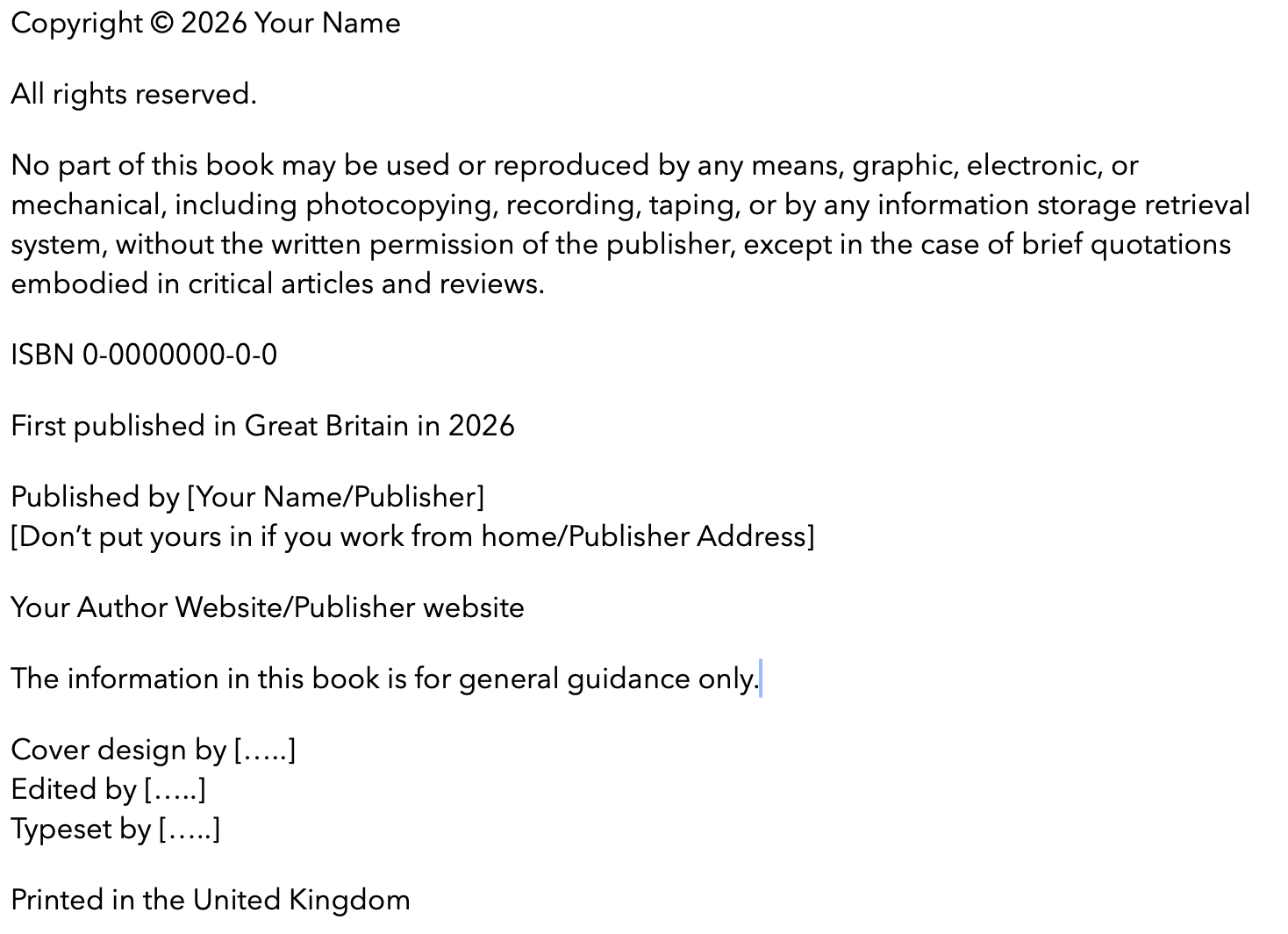
Here’s an example Copyright Page:
I hope this helps xx
If you’re an aspiring author looking to publish your book, I'm here to polish your words and create a professional, reader-friendly publication for you. I would love to support you on your publishing journey.
Contact me for an editing and typesetting estimate; let’s make your book shine!
* * *
Cornerstone pa services is here to help YOU and YOUR business.
Get in touch if you need editorial or admin support.